- Agency
- MTA New York City Transit
- Location
- Brooklyn, New York
- Engagement
- Transit Tech Lab 2026
Exploring a more connected Brooklyn bus network
Modeled results at a glance
- additional annual riders
- 2.1 million
- Estimated ridership increase for the modeled redesign.
- in additional annual fare revenue
- $3.5 million
- Estimated revenue associated with the redesigned network.
- fewer transfers each year
- 2.5 million
- Estimated reduction in transfers across passenger journeys.
Ontra estimates from the proof of concept; not validated by NYCT and not measured outcomes of an implemented network. These findings concern the Brooklyn bus study, separately from the LIRR timetable study.
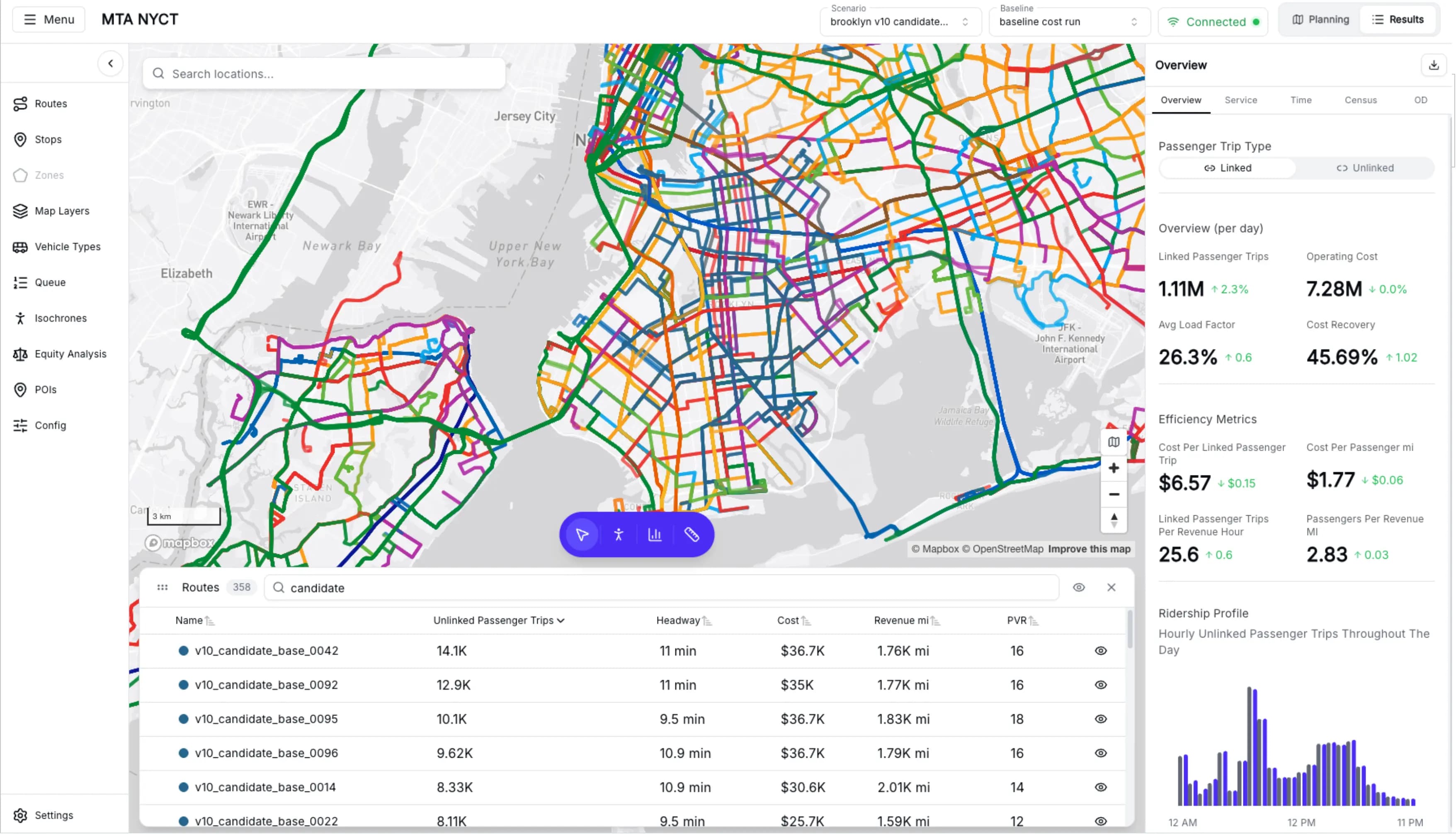
Ontra modeled Brooklyn’s bus network and evaluated a redesign aimed at attracting more riders, reducing transfers, and improving service under operating constraints.
The challenge: improve the network as a whole
Bus routes work together. A change to one route can affect connections, transfers, and the usefulness of service elsewhere in the network. Evaluating a redesign means considering entire passenger journeys alongside individual routes.
As part of Transit Tech Lab’s eight-week Data & Workflow Modernization proof of concept, Ontra worked with NYCT to model and redesign the Brooklyn bus network. The study focused on ridership, convenience, equity, and efficiency.
The approach: connect demand, service, and constraints
The analysis combined bus ridership, origin-destination and path data, GTFS service data, regional demand inputs, the road network, and operating constraints. Together, these inputs support a view of where people want to travel and how the network serves those journeys.
Ontra used demand modeling and optimization to evaluate a redesigned network and estimate its effects on riders. This connects service design choices to predicted network-wide outcomes rather than judging a route in isolation.
The results: more riders and fewer transfers
Ontra estimated that the redesigned network could add about 2.1 million annual riders and generate about $3.5 million in additional annual fare revenue.
The model also estimated about 2.5 million fewer transfers each year. That result highlights the importance of evaluating how routes connect: a service change can improve the passenger journey beyond the time spent on any one bus.
What this gives planners
The study turns a complex network redesign into a set of service choices with explicit predicted impacts. Planners can examine ridership, transfers, and operating considerations together, then use local knowledge and agency review to determine which options deserve further development.